Office building window cleaning guide 2026: professional care
- support760146
- Mar 13
- 10 min read

Most property managers assume window cleaning is purely cosmetic, but it directly impacts your building’s lifespan and tenant satisfaction. Neglected windows accumulate contaminants that cause permanent etching, while clean glass allows up to 50% more natural light, proven to boost employee productivity and reduce stress. This guide reveals how professional cleaning protects your investment, meets safety standards, and adapts to your building’s specific needs. You’ll learn which methods suit different office structures, how often to schedule service, and what preparation maximizes results while minimizing workplace disruption.
Table of Contents
Why Professional Window Cleaning Matters For Your Office Building
Tailoring Cleaning Methods To Your Building’s Needs And Safety Standards
Professional Cleaning Vs. DIY: What Business Owners Should Know
Setting A Cleaning Schedule And Preparing Your Property For Service
Professional Window Cleaning Services In St. Augustine, Ponte Vedra, And Nocatee
Key takeaways
Point | Details |
Window longevity protection | Professional cleaning removes corrosive contaminants before they cause permanent damage |
Productivity enhancement | Natural light through clean windows improves employee focus and mood |
Safety compliance | OSHA regulations require specific fall protection and training for commercial cleaning |
Customized approaches | Building height, glass type, and access points determine the optimal cleaning method |
Investment preservation | Regular maintenance protects glass integrity and reflects quality property management |
Why professional window cleaning matters for your office building
Your office windows face constant assault from environmental contaminants that most property managers overlook until damage appears. Hard water deposits, acid rain, and oxidation embed into glass surfaces, creating permanent etching and microcracks that weaken structural integrity. Once these contaminants bond chemically with the glass, standard cleaning cannot reverse the damage. Professional services remove these threats before they compromise your windows, extending lifespan by years and preventing costly replacements.
The impact on your tenants goes far beyond aesthetics. Studies show that natural light boosts employee productivity while reducing stress hormones and improving sleep quality. Dirty windows block up to 50% of available sunlight, creating dim workspaces that drain energy and focus. Employees in naturally lit offices report higher job satisfaction and fewer sick days. When you invest in regular window cleaning for offices, you’re directly supporting tenant retention and workplace performance.
Building appearance shapes first impressions for potential tenants, clients, and investors. Streaked, grimy windows signal neglect and diminish property value regardless of interior quality. Professional cleaning maintains the polished image that justifies premium lease rates and attracts quality tenants. Consider these core benefits:
Glass protection from permanent environmental damage
Enhanced natural light transmission for occupant well-being
Preserved curb appeal supporting property valuation
Extended window lifespan reducing capital expenditure
Improved tenant satisfaction and retention rates
Pro Tip: Schedule your first professional cleaning during spring or fall when moderate temperatures allow thorough inspection of window condition and frame integrity.
Regular professional maintenance creates a protective cycle. Clean glass resists new contamination better than dirty surfaces, meaning each successive cleaning becomes more efficient. Property managers who establish consistent schedules report lower long-term costs compared to reactive maintenance after damage occurs. Your windows represent a significant capital investment, and professional care ensures that investment appreciates rather than deteriorates.
Tailoring cleaning methods to your building’s needs and safety standards
Your building’s physical characteristics dictate which cleaning methods deliver safe, effective results. Low-rise offices utilize water-fed pole systems, while taller buildings require MEWPs or cradle systems based on access points and height restrictions. A three-story suburban office building needs completely different equipment than a downtown high-rise with limited ground access. Understanding these distinctions helps you evaluate proposals and ensure contractors use appropriate methods for your property.

Glass composition matters as much as building height. Tinted windows, low-emissivity coatings, and laminated safety glass each require specific cleaning solutions and techniques. Standard ammonia-based cleaners can damage specialized coatings, voiding manufacturer warranties and creating permanent haze. Professional services assess your glass type before beginning work, selecting pH-balanced solutions that clean effectively without chemical damage. They also adjust pressure and tool selection for coated versus standard glass.
Access restrictions shape method feasibility and project timing. Buildings with limited ground clearance, adjacent structures, or landscaping obstacles may require boom lifts instead of ground-based poles. Interior cleaning around sensitive equipment or during occupied hours demands different protocols than exterior-only service. High-rise window cleaning often involves coordinating with building management to secure roof access and establish safety perimeters.
Safety regulations are non-negotiable in commercial window cleaning. OSHA requires fall protection for workers above four feet, including harnesses, anchors, and documented training records. Contractors must maintain liability insurance, provide safety data sheets for all chemicals, and follow lockout/tagout procedures near electrical systems. These requirements protect both workers and property owners from catastrophic liability.
Method selection follows a clear hierarchy:
Assess building height and determine maximum reach requirements
Identify glass types and coating specifications from building plans
Evaluate access points including ground clearance and roof anchor availability
Review occupancy schedules to minimize disruption
Confirm contractor safety certifications and insurance coverage
Select equipment matching all identified constraints
| Building Type | Optimal Method | Key Consideration | | — | — | | 1-3 stories | Water-fed poles | Ground access and reach | | 4-8 stories | Boom lifts or scaffolding | Stability and positioning | | 9+ stories | Cradle systems or rope access | Roof anchor certification | | Historic buildings | Manual with specialized tools | Surface preservation |
Pro Tip: Request copies of contractor safety certifications and insurance certificates before signing any service agreement, and verify coverage amounts meet your property insurance requirements.
Timing decisions balance efficiency with occupant comfort. Exterior cleaning during business hours works well with quiet water-fed systems but becomes problematic when using noisy boom lifts or blocking parking areas. Interior cleaning requires coordination with tenant schedules to avoid disrupting meetings or accessing secure areas. Professional contractors develop site-specific plans that account for your building’s operational rhythm.
Professional cleaning vs. DIY: What business owners should know
DIY window cleaning appeals to budget-conscious property managers, but the results rarely match professional standards. Amateur cleaning leaves streaks and static charges that attract dust, requiring more frequent maintenance and creating a perpetual cycle of subpar appearance. Paper towels and standard glass cleaners cannot achieve the optical clarity that professional squeegees and purified water deliver. What seems like cost savings becomes wasted labor when staff spend hours achieving mediocre results.
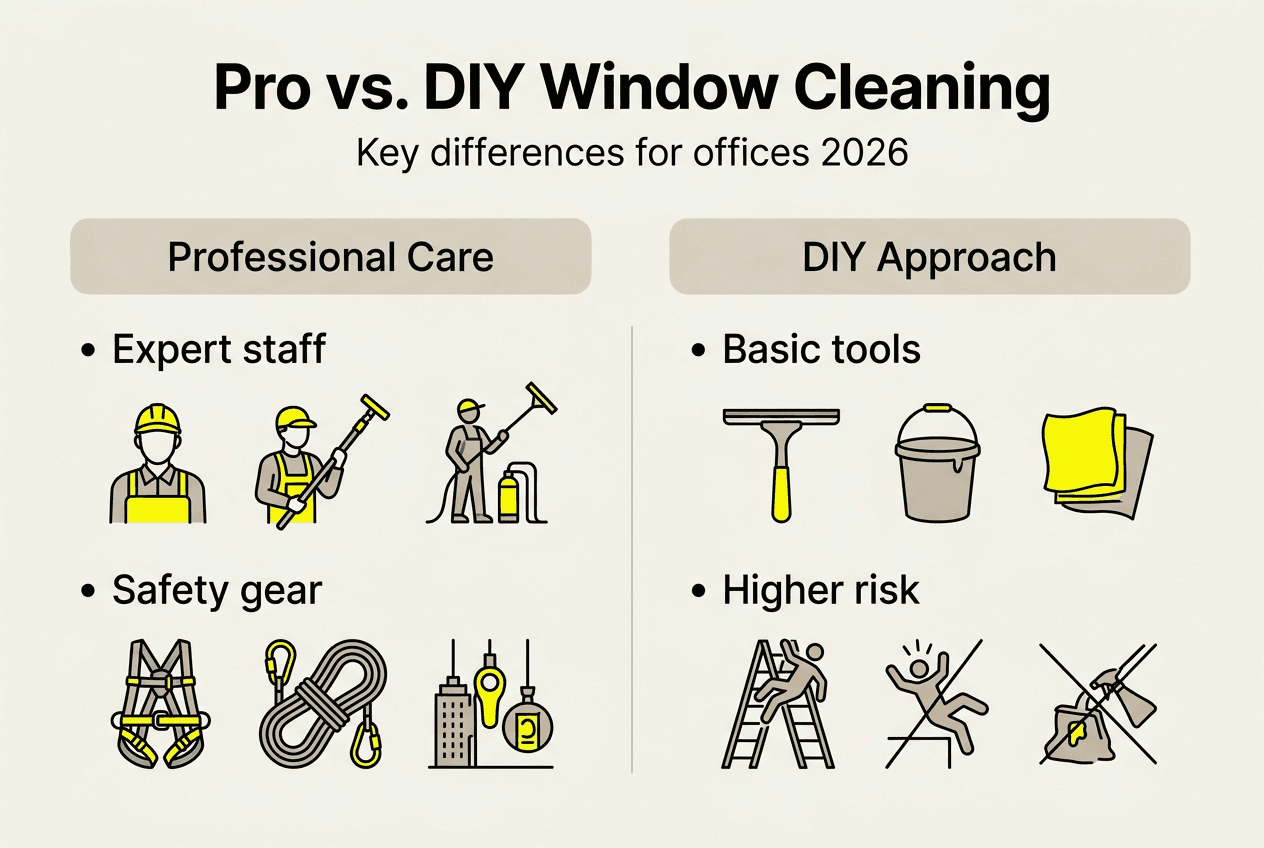
Safety risks escalate dramatically with DIY approaches. Untrained staff using ladders near windows face fall hazards that expose your business to workers’ compensation claims and OSHA violations. Even ground-level cleaning involves slip risks from wet surfaces and chemical exposure without proper protective equipment. Professional window cleaners carry specialized insurance, use certified fall protection, and follow documented safety protocols that protect everyone involved.
Water-fed pole systems reduce ladder dependence, improving both safety and speed for exterior commercial cleaning. These telescoping poles deliver purified water through brush heads, allowing technicians to clean up to 60 feet from ground level. The purified water dries spot-free without squeegee work, eliminating the most dangerous aspect of traditional window cleaning. This technology has transformed commercial cleaning by making multi-story buildings accessible without expensive lift equipment.
Frequency recommendations vary based on environmental exposure and business type. Coastal properties battle salt spray requiring monthly attention, while inland suburban offices may need only quarterly service. High-traffic retail spaces benefit from bi-weekly cleaning to maintain premium appearance, whereas back-office buildings function well with seasonal schedules. Professional services assess your specific conditions and recommend frequencies that balance appearance with budget.
Consider these practical differences:
Equipment quality: Professional-grade squeegees, purified water systems, and extension poles versus household spray bottles and paper towels
Chemical selection: pH-balanced, coating-safe solutions versus generic ammonia cleaners
Technique expertise: Trained methods preventing streaks and damage versus trial-and-error approaches
Safety compliance: Certified fall protection and insurance versus unprotected ladder use
Time efficiency: Experienced crews completing buildings in hours versus days of staff distraction
| Aspect | DIY Approach | Professional Service | | — | — | | Typical result quality | Streaky, inconsistent | Crystal clear, uniform | | Safety equipment | Basic ladders, minimal protection | Certified harnesses, insured crews | | Time investment | 3-5x longer for same area | Optimized with specialized tools | | Chemical knowledge | Generic household products | Coating-specific, eco-friendly options | | Liability coverage | Property owner assumes all risk | Contractor insurance protects owner |
Pro Tip: Calculate the true cost of DIY by factoring staff hourly rates, equipment purchases, and potential injury liability, then compare against professional quotes for an accurate cost analysis.
Professional scheduling minimizes workplace disruption through strategic timing and efficient execution. Contractors coordinate with property managers to identify low-traffic periods, secure necessary access, and complete work within compressed timeframes. They bring complete equipment sets, eliminating the back-and-forth trips that plague amateur efforts. Many services offer flexible scheduling including evening and weekend availability to avoid peak business hours entirely.
The quality difference becomes obvious within weeks. Professional cleaning creates hydrophobic surfaces that repel water and resist contamination, keeping windows cleaner longer between services. Modern cleaning techniques also address frames, tracks, and seals, preventing the buildup that causes operational problems and water intrusion. This comprehensive approach maintains your entire window system, not just the visible glass.
Setting a cleaning schedule and preparing your property for service
Establishing the right cleaning frequency protects your investment without overspending on unnecessary service. Frequency depends on location and business type, ranging from monthly coastal maintenance to bi-annual inland schedules. Buildings near construction sites, highways, or industrial areas accumulate grime faster than those in residential neighborhoods. Medical offices and professional services firms typically maintain more aggressive schedules than warehouses or manufacturing facilities where appearance standards differ.
Environmental factors override general recommendations. Salt air, pollen seasons, and storm frequency all accelerate contamination. Properties with significant tree coverage battle sap and organic debris requiring quarterly attention minimum. Urban locations face exhaust particulates and pollution that embed in glass surfaces. Smart property managers track their building’s specific accumulation patterns over the first year, then adjust schedules based on observed needs rather than generic advice.
Preparation maximizes efficiency and protects your property during service. Notify tenants at least 48 hours before scheduled cleaning, especially for interior work requiring workspace access. Clear window areas of furniture, plants, and decorative items that obstruct access or risk damage. Identify and communicate any special concerns like sensitive equipment near windows, security system contacts, or areas requiring escort access. Professional contractors appreciate detailed site information that prevents surprises and delays.
Weather monitoring protects both workers and results. Exterior cleaning should not occur above 40 km/h wind speeds due to safety risks and solution drift. Freezing temperatures prevent proper cleaning and can damage equipment. Light rain actually benefits water-fed pole cleaning by rinsing away loosened contaminants, but heavy storms require rescheduling. Contractors typically monitor forecasts and communicate proactively about weather-related changes.
Follow this preparation sequence:
Schedule service during low-occupancy periods when possible
Send tenant notifications with date, time, and expected duration
Clear window areas of obstructions and fragile items
Identify and mark any damaged windows needing special attention
Arrange building access including keys, codes, and parking permits
Designate an on-site contact for questions or issues
Confirm weather forecast 24 hours before scheduled service
Coordination details matter for smooth execution. Provide contractors with building access information, parking locations, water source access, and any restrictions on equipment placement. Identify loading zones for boom lifts or scaffolding if needed. Discuss noise limitations and tenant sensitivity to ensure appropriate method selection. Clear communication prevents misunderstandings and ensures your office window cleaning proceeds efficiently.
Seasonal considerations optimize both appearance and cost:
Spring cleaning removes winter grime and prepares for increased natural light usage
Summer maintenance battles pollen, insects, and storm residue
Fall service clears debris before winter weather compounds problems
Winter cleaning focuses on interior surfaces when exterior work becomes impractical
Post-service inspection ensures quality and identifies any concerns requiring follow-up. Walk the building’s perimeter checking for missed spots, streaks, or damage. Test window operation to confirm cleaning didn’t affect hardware function. Document the condition with dated photos creating a baseline for the next service interval. Professional contractors welcome feedback and typically offer satisfaction guarantees covering legitimate quality concerns.
Professional window cleaning services in St. Augustine, Ponte Vedra, and Nocatee
Your commercial property deserves specialized care that protects your investment while enhancing tenant satisfaction. Professional services bring safety-certified crews, commercial-grade equipment, and proven techniques that deliver superior results without disrupting your business operations. Whether you manage a low-rise office complex or coordinate multi-building portfolios, expert window cleaning maintains the polished appearance that supports premium positioning in competitive markets.

Local expertise makes the difference in coastal environments where salt air and humidity accelerate window degradation. Experienced teams understand regional challenges and adapt methods to protect your specific glass types and building configurations. Flexible scheduling accommodates your operational needs, with service available during business hours or after-hours to minimize tenant impact. Comprehensive window washing services address frames, tracks, and seals alongside glass surfaces, ensuring complete system maintenance. Expand your property care with integrated office cleaning and commercial cleaning solutions that maintain consistent quality throughout your facilities.
FAQ
What is the best frequency for office window cleaning?
Frequency varies by location and business type, typically ranging from monthly to bi-annual schedules. Coastal properties and high-visibility professional offices benefit from monthly service, while inland suburban buildings often maintain quality with quarterly cleaning. Environmental factors like nearby construction, heavy traffic, or significant tree coverage may require more frequent attention to prevent permanent damage from accumulated contaminants.
Are commercial window cleaners required to follow safety regulations?
Yes, OSHA mandates fall protection equipment and documented safety training for any work above four feet. Commercial contractors must maintain current certifications, carry liability insurance, and follow strict protocols for equipment inspection and use. These regulations protect workers from injury while minimizing property owner liability for accidents during service.
Can window cleaning be done during office hours without disruption?
Modern water-fed pole systems allow quiet exterior cleaning during normal business hours with minimal disruption. Interior cleaning requires coordination with tenant schedules but can proceed efficiently with proper planning and communication. More complex tasks involving boom lifts or extensive interior work are often scheduled during evenings or weekends to avoid interfering with business operations.
How do professionals clean windows on tall office buildings safely?
Tall buildings require specialized equipment including boom lifts, suspended cradle systems, or rope access techniques depending on building design and roof anchor availability. All methods must meet OSHA fall protection standards with certified equipment, trained operators, and documented safety procedures. Professional contractors assess each building’s specific characteristics to determine the safest, most efficient approach for that structure.
What preparation do property managers need before scheduled window cleaning?
Notify tenants at least 48 hours in advance, clear window areas of obstructions, and provide contractors with building access information including keys, codes, and parking arrangements. Identify any damaged windows or special concerns requiring extra attention. Designate an on-site contact for questions and confirm weather conditions 24 hours before service to avoid unnecessary delays or rescheduling.
Recommended
Comments